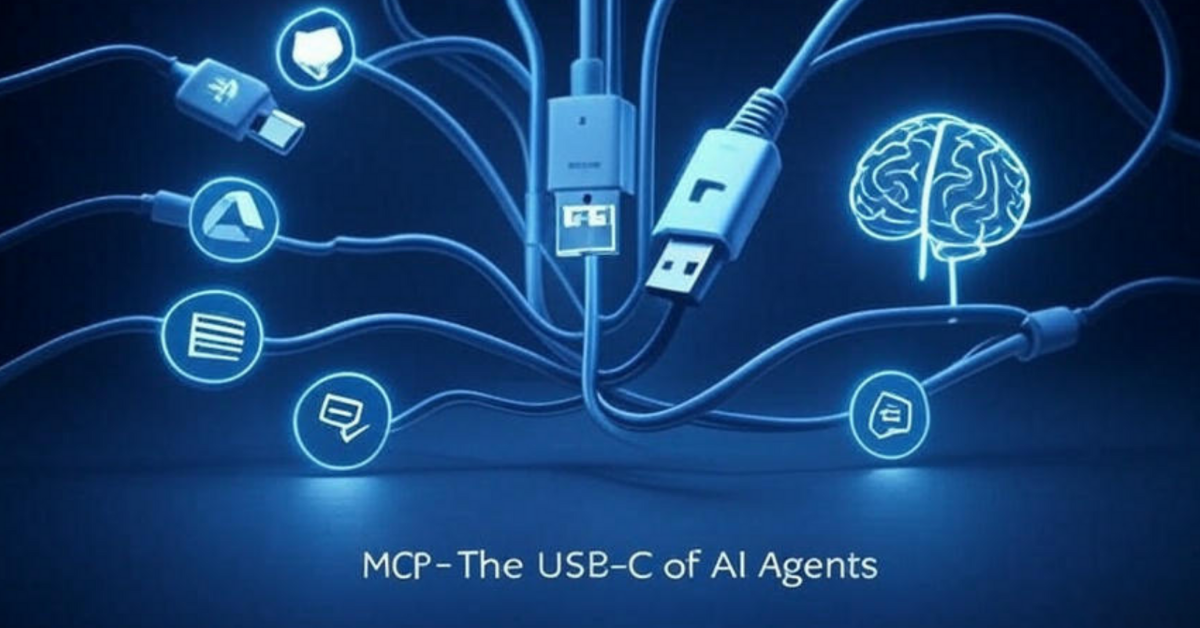
Artificial Intelligence (AI) is rapidly transforming from simple chatbots into powerful AI agents capable of performing real-world tasks, automating workflows, and connecting with external systems. But there has always been a problem: every agent and every tool speaks a slightly different “language.”
This lack of standardization has slowed down the growth of AI-powered applications. Developers often spend more time building integrations than creating useful features.
The solution is MCP – Model Context Protocol.
MCP is an open standard protocol designed to help AI agents easily connect with external tools, databases, APIs, and real-world systems. It is often called the “USB-C of AI”, because just like USB-C simplified hardware connections, MCP simplifies how AI agents integrate with different technologies.
In this article, we will explore:
- What MCP is and how it works
- Why MCP is important for the future of AI
- Real-world examples and use cases
- Benefits for developers, businesses, and enterprises
- The future of AI agents with MCP
Why MCP is Called the “USB-C for AI”?
Before MCP, AI agents and tools needed custom integrations. If you had 5 agents and 10 tools, you had to build 50 different integrations. This was costly, slow, and complex.
MCP changes this by introducing a modular standard. Instead of connecting each tool individually to every agent, developers only need to build one connection per tool and one connection per agent.
This means:
- Faster integrations
- Lower development costs
- Better interoperability across platforms
- Easy scalability for new tools and agents
How MCP Works
MCP works on a client-server architecture using JSON-RPC 2.0 as its base. It has three main components:
1. Host
The AI application (like ChatGPT, Claude, or an IDE) where the user interacts with the agent.
2. Client
A built-in component in the Host that communicates with MCP Servers.
3. Server
External systems that provide services, tools, or resources to the AI agent.
What MCP Servers Provide
- Tools – predefined actions (e.g., send an email, fetch data, update a record).
- Resources – external data (e.g., Google Drive files, GitHub repos, SQL databases).
- Prompts – reusable instruction templates.
- Sampling – requests for the agent to take specific actions.
Key Benefits of MCP
- Standardization – One protocol to connect any agent with any tool.
- Interoperability – AI frameworks and tools can work together seamlessly.
- Scalability – Adding new tools or agents is easy and cost-effective.
- Developer Freedom – Developers can focus on building smart tools instead of wasting time on custom integrations.
- Future-Proofing – Agents will still work even if the underlying AI model changes.
MCP in Action: Real-World Use Cases
1. Block’s “Goose” AI Agent
Block uses MCP for its internal AI agent “Goose.” Goose can:
- Write and execute SQL queries
- Integrate with internal support systems (like Beacon)
- Automate workflows such as ticket closure
2. Developer Tools & IDEs
In coding environments, MCP allows agents to:
- Fetch context from GitHub, Git, or documentation sources
- Use debugging tools
- Help developers write better, faster, and cleaner code
3. Open-Source AI Frameworks
Several popular frameworks are already using MCP:
- LangChain – integrates MCP tools into agent workflows
- CrewAI – loads MCP servers to empower multi-agent systems
- AutoGen – uses MCP tools for web content fetching and automation
How MCP Improves AI Agents
1. Smarter Memory
With MCP, agents can access long-term memory by connecting to vector databases or knowledge bases.
2. Stronger Intelligence
Agents become more context-aware because they can directly pull information from resources like Google Drive, Databricks, or GitHub.
3. Better Collaboration
MCP supports multi-agent workflows, where one AI agent can act as a tool for another agent. This allows for complex task automation across teams and enterprises.
Why MCP Matters for Businesses
For companies, MCP provides:
- Lower costs (less development time and maintenance)
- Faster innovation (new AI tools can be plugged in instantly)
- Better security and compliance (MCP servers can be designed to meet enterprise-grade requirements)
- Competitive advantage (businesses can scale AI faster than competitors)
Future of MCP: Multi-Agent Collaboration
The future of AI will not be single agents working in isolation. Instead, multiple AI agents will:
- Collaborate with each other
- Share resources
- Automate end-to-end workflows
Imagine a scenario where:
- One agent analyzes financial data
- Another agent prepares a report
- A third agent sends it to stakeholders
All of this can happen automatically through MCP.
Final Thoughts
AI agents are the next evolution of Artificial Intelligence. But without standardization, their growth will always be limited. MCP solves this by providing a universal, open standard for tool and data integration.
By calling it the “USB-C for AI”, experts highlight its potential to become the default protocol for all future AI systems.
Businesses, developers, and enterprises adopting MCP early will have a strong competitive advantage in building intelligent, scalable, and future-proof AI applications.